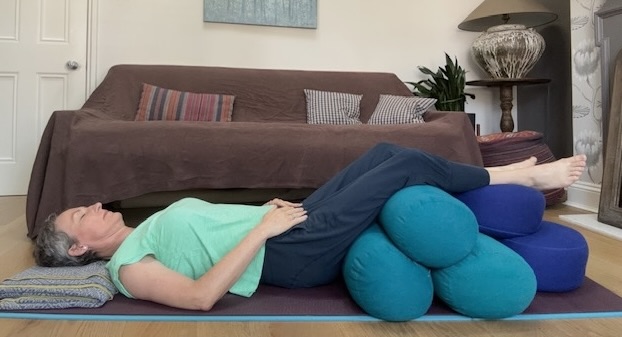
I have been struggling with hip pain and sciatica. While waiting for the pain to subside, I have been very grateful for yoga. Small, mindful movements in coordination with the breath, and restorative rest positions are helping me through this challenging period. On top of that, it is simple, slow breathing that is helping me most mentally. When the body is in pain, the mind tends to run away with fear. We ask ourselves whether this pain will ever end. What if we can never go back to the life that was lived so carelessly? Whereas the stress of these worries can make the pain worse, breathing relaxes the mind, and anchors us in the present moment. This blog explains how slow breathing can help you manage pain and gives you some breathing techniques to try. Regularly paying attention to the breath can make us feel more relaxed and give us the courage to carry on.
When the body is in pain, muscles tighten and the breath becomes shallow and fast. It may even feel like you are holding your breath frequently, like the pain is taking your breath away. Similar to mental stress and anxiety, being in pain activates the stress response in the body. This triggers fast breathing and muscle activation. Through slow breathing, we can encourage our muscles to relax and help our mind to face the pain and deal with it in a better way. Doing breathing awareness regularly can override our tendency to add the stress of shallow breathing upon the stress of being in pain. Let’s first examine our natural breathing mechanism and then why the breath becomes changes when we are in pain.
Our natural breathing pattern
The diaphragm is our main respiratory muscle. It is a large, dome-like structure which lies underneath the lungs and the heart, and above the abdominal cavity. When it contracts and descends, the lungs expand and air is sucked in. The abdominal organs are pushed down and out while getting a lovely massage by this moving muscle. When the diaphragm relaxes, the lungs deflate, abdominal organs move back and carbon dioxide leaves the body. Other respiratory muscles help with this process, to help expand the ribcage. Still others are engaged for a deeper breath or forced exhalation.
There are many causes that can disturb this natural pattern. When we are stressed, in pain or anxious, the diaphragm tends to tighten and move less fully. As a result, the other respiratory muscles have to work harder, which is not as efficient, leads to exhaustion, muscle tightness and less optimal health.
Shallow breathing
We can see a shallow breathing pattern in someone when their ribcage and shoulders are moving too much with every breath. Of course, when we do aerobic exercise, or we need to run to catch the bus, we need more oxygen. Then the ribcage will move more, as well as the abdomen. In restful breathing, however, the abdomen moves up and down, the side ribs move out to the side, but the upper ribcage is fairly quiet.
When the diaphragm is tight and not moving freely, our back muscles suffer and tighten as well. This can happen the other way round as well. One reason for this is that the diaphragm attaches along the front of the lumbar vertebrae, and thus its movements affect the spine. Furthermore, the tendons of the diaphragm share attachments with other major back muscles, such as the psoas. When chronically contracted, the diaphragm increases the tension and tightness in the lower back muscles. By contrast, a freely moving diaphragm provides a constant, healthy movement for the spine, and helps to keep more space between the vertebrae, which is essential for back health. I have written more about the connection between breathing and back health in this blog: https://beneyoga.co.uk/using-the-breath-to-heal-lower-back-pain-2/.

Free, healthy breathing
So now let’s turn our attention to a healthy breathing pattern. Many people confuse healthy breathing with deep breathing, or with abdominal breathing. As we already saw in the example of running for the bus, healthy breathing can mean that the ribcage moves more because we need more oxygen. This is deep and healthy breathing, although not restful breathing. Indeed, deep breaths using all the respiratory muscles, are energising.
Breathing without too much movement of the ribcage, primarily using the diaphragm, is more restful and slower. We can see this pattern in a person when the abdomen and the lower abdomen moves up with the inhalation and down with the exhalation. This slower breathing signals to the body that it is time to rest and digest.
The beautiful part of this is that we can control it. We can consciously slow our breath down by observing it, preferably in a quiet environment. Slow breathing can lower our heart rate and even our blood pressure. It also helps to relax muscles, as these are not getting the message that they have to ‘fight or flee’. Finally, slow breathing allows more oxygen to reach and oxygenate the cells, which benefits our overall wellbeing.
Breathing in the present moment
During this current time of acute pain, I have benefited from Jon Kabat-Zinn’s mindfulness meditation for pain relief. He wrote about this in his book “Full Catastrophe Living” and also has a helpful app. Jon Kabat-Zinn explains that while our thoughts often project us into fear, worst possible outcomes and obsessive thought about the pain, breathing can anchor our mind in the present moment. To begin with, this mental focus allows us to feel more peaceful. Additionally, when we are not obsessing about our pain, mindful breathing connects us with the beauty or simply the reality of the present moment.

Breathing technique to help us manage pain
Once you have mastered abdominal breathing in a supine position, you can also practise it sitting. Let’s start lying on the back if you can, in a comfortable position. To find a restful supine position that feels just right, you can read this blog: https://beneyoga.co.uk/restorative-yoga/.
Breathe in and out through the nose if you can.
Place your hands on your abdomen and simply feel the movement of your breath. When you breathe in, your hands move up gently. When you breathe out, the abdominal wall rests down.
Follow especially your exhalation until it feels naturally finished. The inhalation will take care of itself.
Keep paying attention to the breath and allow it to slow down by itself, simply by watching it. This means we observe the breath but we don’t change it forcibly. When we are in pain, any forced breathing methods can inject a subtle element of stress and tension. This can be true even during apparently very mild breathing methods such as counting the breath.
If you are in pain, see if you can breathe into the pain. For this, breathe in lightly and visualise or feel that the breath travels into the painful area. As you exhale, imagine that the breath leaves that area, together with a little bit of the pain. While doing that, also become aware of the areas in the body that don’t hurt. Enjoy these areas that feel lighter.
Namaste